Private Spaces · La Habra Heights
RV Garages — The tall, deep, simply-finished building most owners haven’t done the math on.
An RV garage is one of the most flexible accessory structures California zoning permits on a hillside acre lot. Here is what it is, what it does — and what twenty years of building them in La Habra Heights has taught us.
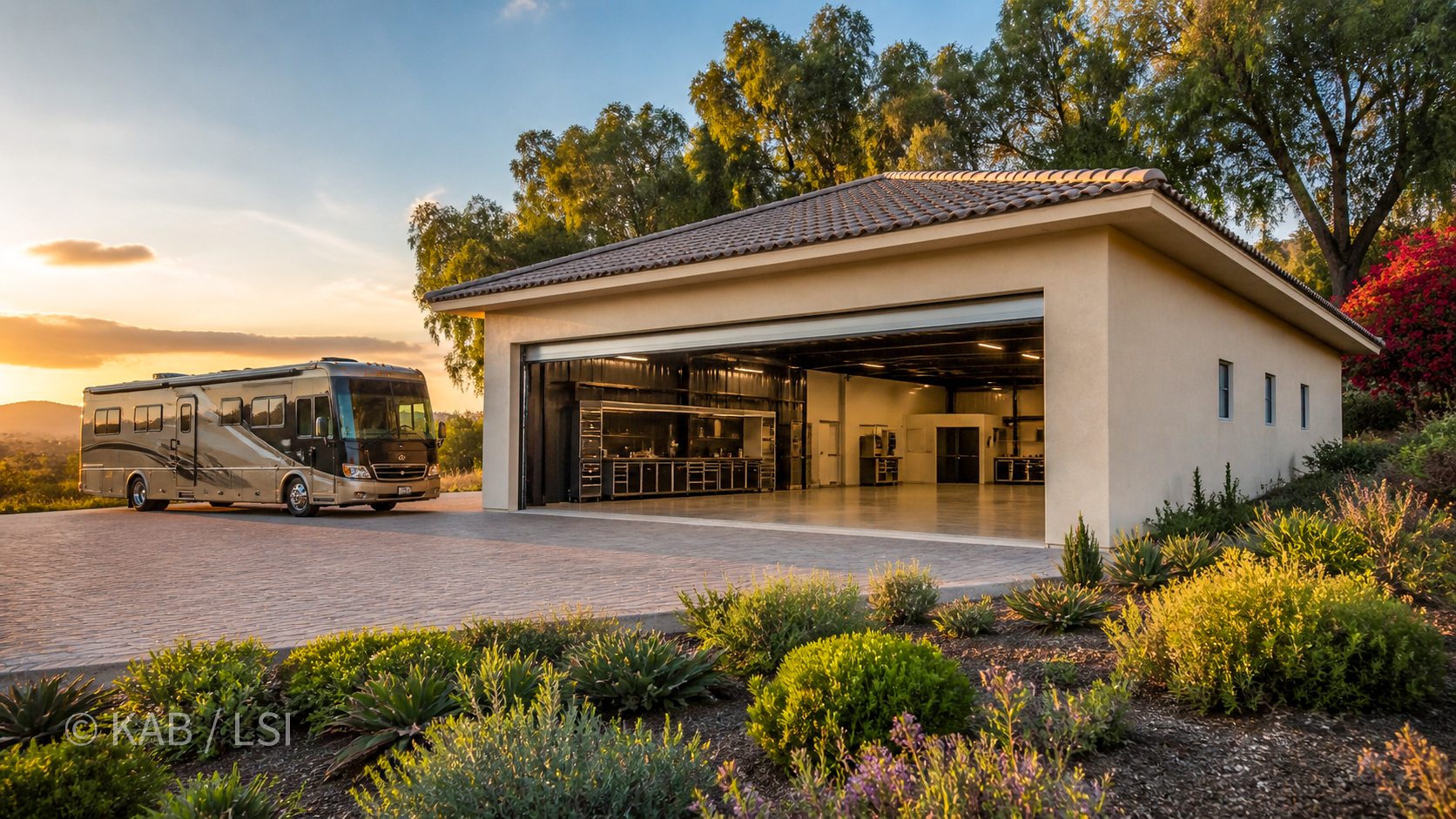
On a hillside acre+ lot, the smartest single structure isn’t always an ADU.
It is often the one with the wide door, humongous floor space and the tall ceiling.
In the 1990’s I started noticing something. The owners getting the highest resale on hillside acre lots weren’t the ones who’d built the fanciest house. They were the ones who’d added a structure most people overlook — a tall, deep, simply-finished accessory building. Permitted as an RV garage. Used as whatever made sense.
I’ve been building them for twenty years. Here’s why.
How a buyer actually finds your house.
Savvy home shoppers search by filter — “RV garage,” “detached office,” “cul-de-sac,” “lot over 20,000 square feet” — and land where the property can finally become what they’ve been picturing.
An RV garage is a blank canvas.
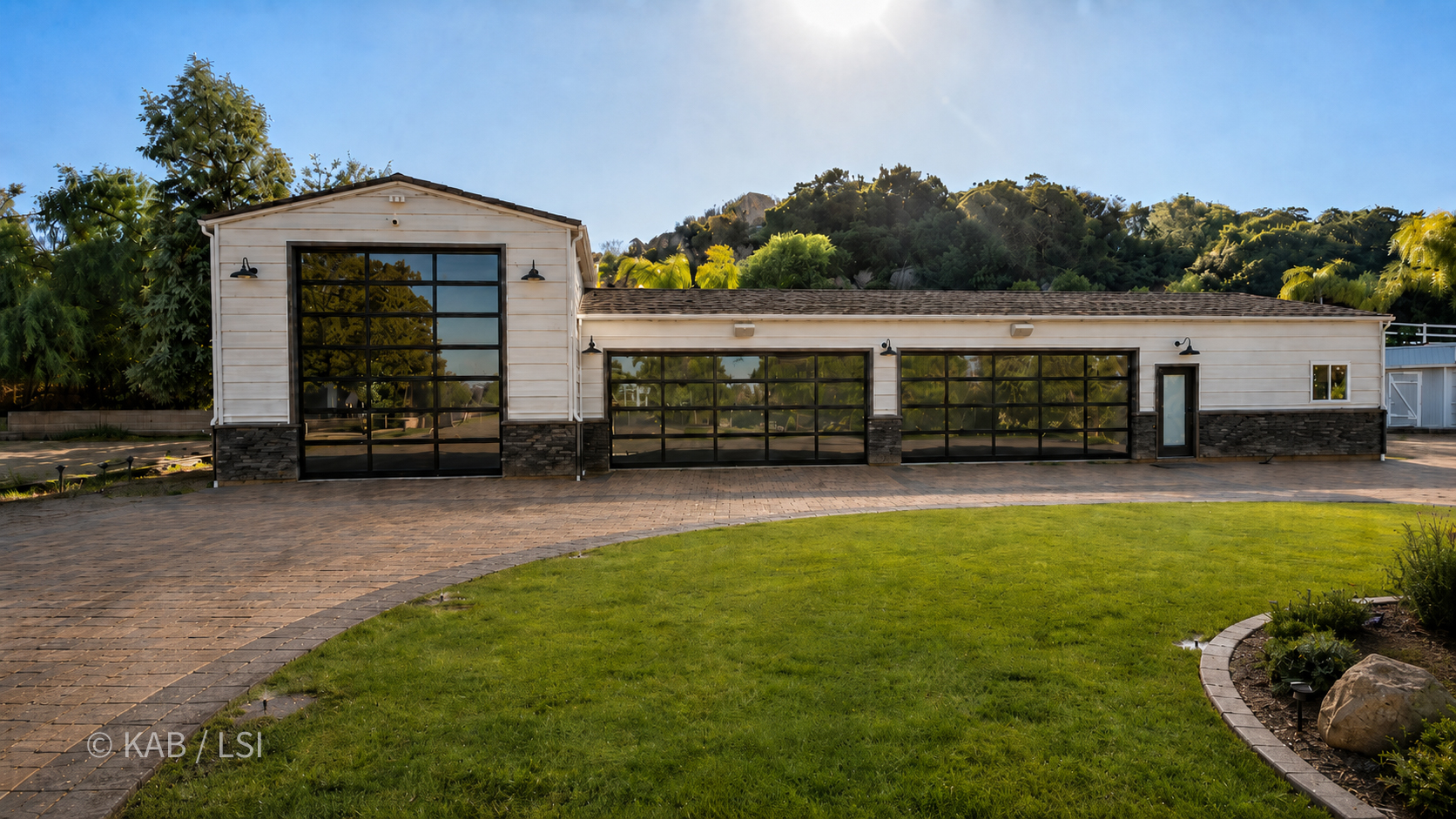
No. 1
RV Garage · 4-Car Garage · Pro Office · Guest Room Behind
From the curb, it’s just a beautiful building.
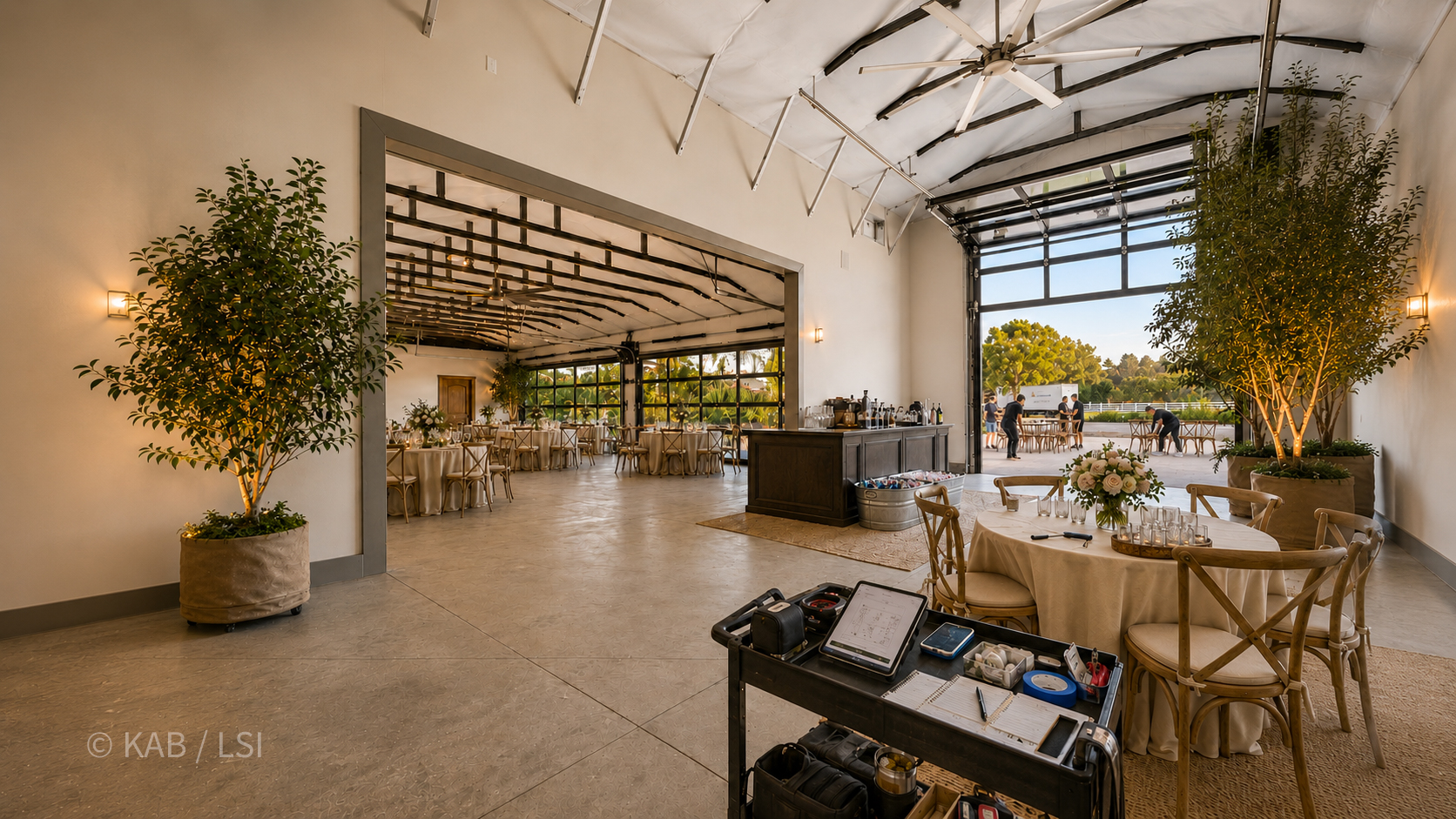
No. 2
RV Garage Interior · Wedding Reception
A daughter got married inside this spacious RV garage. Some might call this “flex-space.”
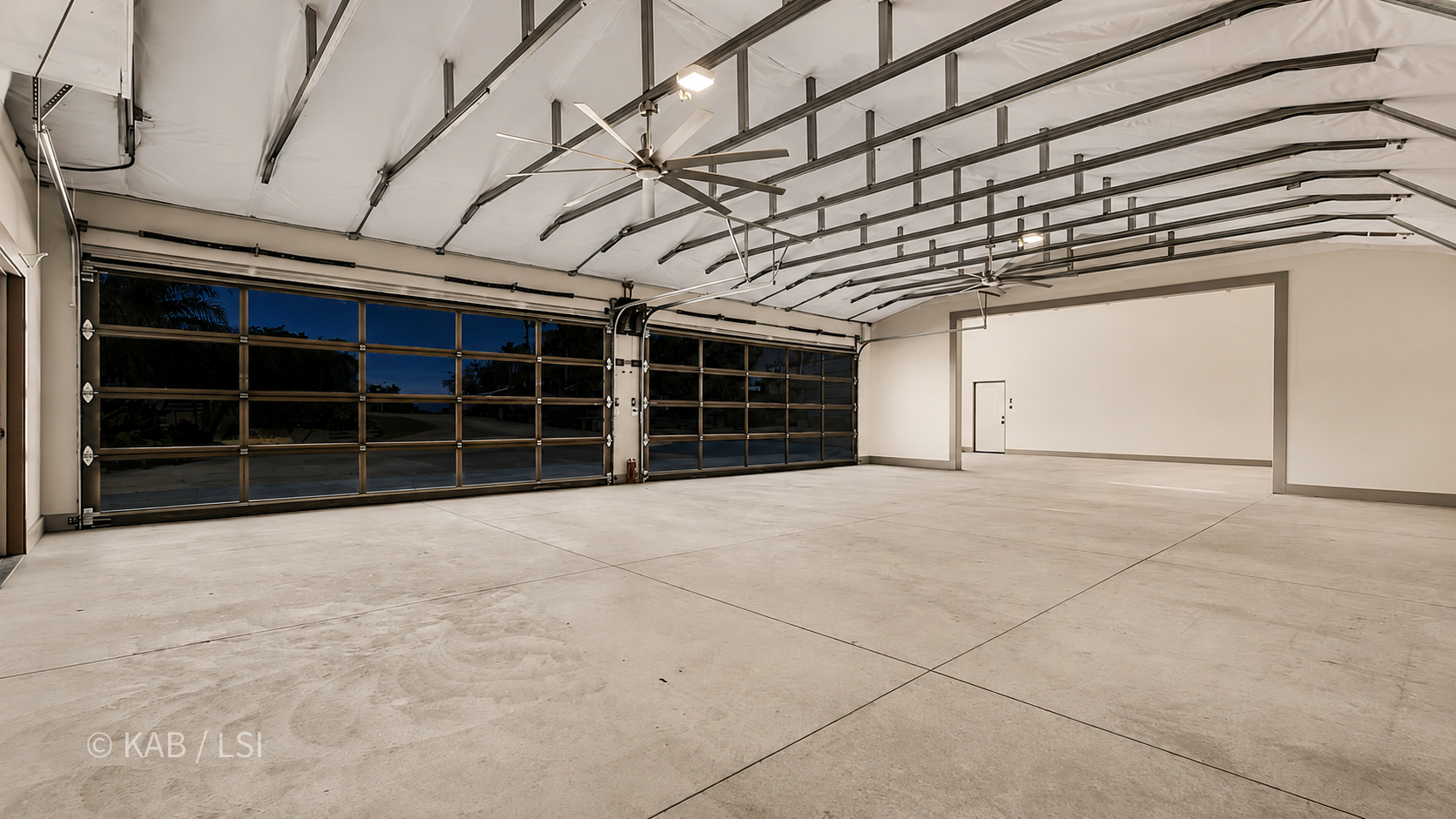
No. 3
4-Car Garage Interior · Peek into RV Garage
On any given Tuesday, this is a contractor’s headquarters, a workshop, a film studio, or an empty stage waiting for what’s next.
Filter the right way and your property surfaces in a search where almost nothing else does. Hillside lots with RV garages are scarce. Build one, and you’re in a smaller pool of listings, in front of buyers who already know what they want — and most of them don’t own an RV. They’ve figured out that “RV garage” is shorthand for the private space that zoning won’t let them call by its real name.
That’s not curb appeal. That’s findability.
What the permit calls a garage. What life calls something else.
On the tax rolls, it may be a garage. On the permit, it may be a garage. But on a La Habra Heights property — where one acre is the minimum lot size and many sit on more — a structure like this becomes something much more flexible: a place for the contracting business you no longer want to lease space for, the service vehicles you want off the street, the home office that finally belongs outside the house, the car collection, the motorsports toys, the boats, the trailers, the online business, the weekend project, or that experimental airplane you still swear you might build someday.
And yes, it can still hold the RV. But it can also become overflow for the family compound — a reception space, a holiday gathering room, a quinceañera setup, a guest-ready wing, a serious workshop, a private office, or simply paid-for square footage within walking distance of your kitchen, your family, and your own front door.
1 Accessory structure rules vary by jurisdiction, by lot, and by use. Permitted use is what the city signed off on at the time of permit issuance — not necessarily the full range of activities the structure can physically accommodate. Owners considering an RV garage or similar accessory structure should consult their local planning and building departments before construction, and again before changing how the structure is used. ↩
Why home shoppers add a keyword to their Zillow search. “RV GARAGE.”
They know what the filter is really filtering for:
Sixteen to twenty-foot ceilings. A door tall enough to drive something tall through. A bay deep enough to fit something serious. A ceiling high enough for an HVAC contractor to have storage racks next to his service vans. A concrete floor that is solid, flat, and can handle a forklift or a BendPak® car lift. All that space — and none of the rules a habitable structure of this size would carry.
Savvy buyers — with intellect, wisdom, and means — small business owners, entrepreneurs, hobbyists, multi-generational families, people who’ve outgrown their existing garage and subdivision house — know that high-roof flex space is the rarest and most expensive thing to add later. So they filter for it now.
Entrepreneurs by definition. Side-business owners. Parents preparing for what comes next.
The RV garage is one of the most useful accessory structures California zoning permits on a hillside acre lot. It’s permitted for storage, built tall and deep and unfinished by design, and the owner determines how to use the interior space within the limits of the permit and the building code.1 Used within those limits, the structure becomes whatever the owner needs — a workshop, a private office, a recreational vehicle bay, additional storage — without the regulatory weight of a habitable structure.
Smart owners don’t build buildings. They build options.
The secret hills, and the lifestyle you didn’t know existed.
Most people drive past La Habra Heights twice a week for a decade without ever once looking up.
From the 60 freeway, from Whittier Boulevard, from the back lots of the old Standard Oil tank farm in La Mirada, the hill is just terrain — a green shape in the distance you’ve stopped registering. Even if you grew up in Hacienda Heights, you’ve probably never been up here. There’s no destination up here. No Starbucks. No reason to leave the surface streets and turn up Hacienda Road unless somebody who lives here invites you.
Most of the people who actually live up here forgot the hill exists too. Not the front view — they remember the front view. They remember the night Catalina was sitting on the water like a model someone had set down for them to look at. But the other 90% of the lot. The slope behind the garage where the avocado trees used to be. The flat below the master bedroom where the kids built a fort in 1998 and nobody’s walked since. The corner where, between November and February in the late afternoon, the light comes through the gap between the oaks and lands on a patch of dirt nobody’s looked at in eleven years.
What I do — I help my neighbors see what they already own.
After forty-five years on this hill and thousands of glimpses into how people live up here, I’ve learned that savvy neighbors — the ones whose property works for them daily — are scarce. Most owners are using somewhere between 5 and 10 percent of their lot. The house has a footprint. The driveway has a footprint. Everything else is a weed-eater problem in fire season and a gardener invoice the rest of the year.
I don’t build it anymore. I help find it. I fly the property and produce a Sightlines study — what each corner of the lot can actually see, and from what height. I walk it with the owner and mark the spots where a future destination earns its keep. I help map the pathways. I bring the trades when it’s time, one phase at a time, sometimes a quarter-acre at a time, on a schedule the owner can live with.
Most of what changes on these properties isn’t a bigger house. It’s a reason to go outside again — and a slow, methodical, honest expansion of the private space the owner already owns and has stopped seeing.
The longer version — The Vision Walk →
Six things people actually do with them.
In ten years of building these in La Habra Heights, here’s what I’ve seen.
Contractor van fleet.
Plumbing, electrical, HVAC. Three or four service vans parked overnight, locked, dry, off the street.
The tenant who pays a premium for the structure.
In the San Gabriel Valley — on a corner half-acre property I made over for a client in 2007 — the RV garage we built was twenty-two feet wide, sixty feet deep, eighteen-foot ceilings, with an attached two-car garage and two driveways, one from each street. It has been continuously leased ever since.
The family that rents it doesn’t live in the front house. They run a small business out of the back. They started with bouncy houses — the kind that take a whole bay to inflate and a whole afternoon to clean — and grew it into a full backyard-event operation: hundreds of folding chairs, dozens of round and rectangular tables, stacks of washable linens, cases of plates and cups and cutlery, stainless drink dispensers, food trays. They added catering. They installed a commercial ice machine — the kind hotels and banquet kitchens keep for buffet service, not the one that fills a room bucket. They eventually added a small luxury-vehicle side business, two black SUVs they keep parked alongside the rest of the inventory and rent out when an event isn’t running.
None of it would fit in a normal residential garage. Hardly any of it would survive being stored outdoors. The 22-foot-by-60-foot bay, the eighteen-foot ceiling, the two driveways onto two streets, and the attached second garage make it possible. The structure pays its own mortgage and most of the property’s, and has done so for eighteen years.
From my client’s view deck up here in La Habra Heights, she can see the San Gabriel Valley laid out below her — fifteen miles to her income property, fifty miles beyond it to the San Gabriel Mountains, west to Beverly Hills, and on a clear winter day, all the way to Big Bear. The corner lot is down there, somewhere in the grid. The income it produces is up here, on two LHH hillside estates that she and her brother live in, with view decks and destination paths and a quality of life that the corner lot in the valley quietly underwrites.
That’s the part most owners haven’t done the math on. A correctly-sized accessory structure on a corner lot, a flag lot, or any property with legitimate vehicular access can carry itself — not as a flip, not as a short-term rental, but as a long-term workspace lease to a small business operator who needs exactly the kind of room a properly-built RV garage actually provides. You can build one up here in the Heights for your own use. You can also build one down in the suburbs you came from, to help support the life you’ve chosen up here. We’ve proven both.
Motorsport bay.
Project car, boat, motorcycles, welding cart, the workbench the regular garage couldn’t hold.
The barn, the shop.
Hay, feed, the riding mower for an acre lot. Or the cabinet maker. Or the welder. Old-school work, finally with the right room.
The bathroom in the corner.
You don’t track grease into the master bathroom. There’s a three-quarter bath right inside the garage — sink, shower, toilet — and just outside it, a stainless commercial sink set into the shop wall for whatever the day calls for: rinsing tools, rinsing the dog, soaking parts. A microwave for a quick lunch you don’t have to walk back to the house for. A second fridge already stocked with beer and sodas for when company shows up unannounced.
Plumb the structure for full RV hookup — potable water, gray water, black water to septic, power, internet — and your parked motor home becomes a self-contained guest suite the night family arrives. No more dumping at a public station after a week-long trip; you do it at home.
And someday, when the kids move home or the in-laws need a place, the bones are already there for a livable arrangement, on whatever terms the city allows at the time you ask.
The actual RV.
Sometimes — a Foretravel, a Class A, the boat on the trailer. A real RV in a garage built for one. It still happens.
A less-discussed use: home-based business or professional office.
For doctors, therapists, lawyers, pastors — anyone whose practice needs a confidential, soundproofed, code-compliant workspace separate from the home.
The lifestyle build. A serious home gym, a show car, a content studio in the corner. The same shell does all three because it has the height and the floor space.
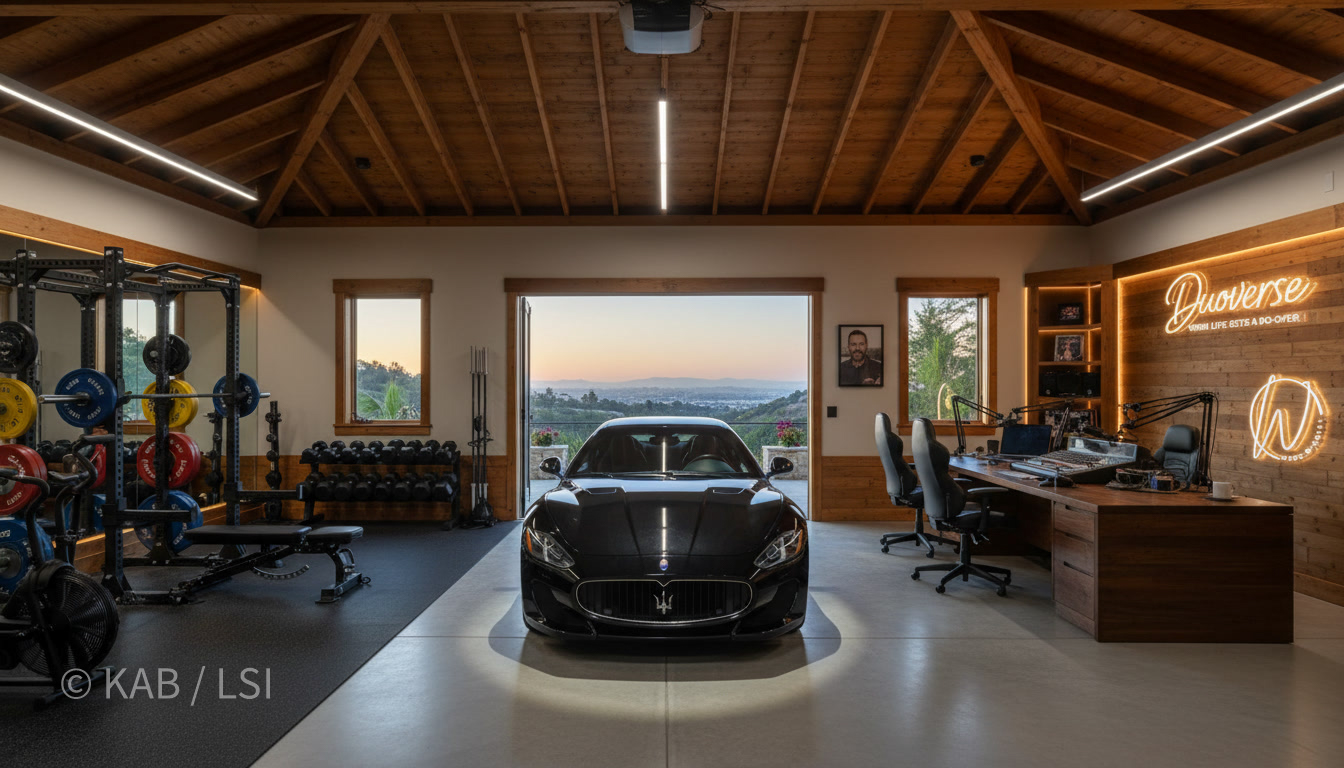
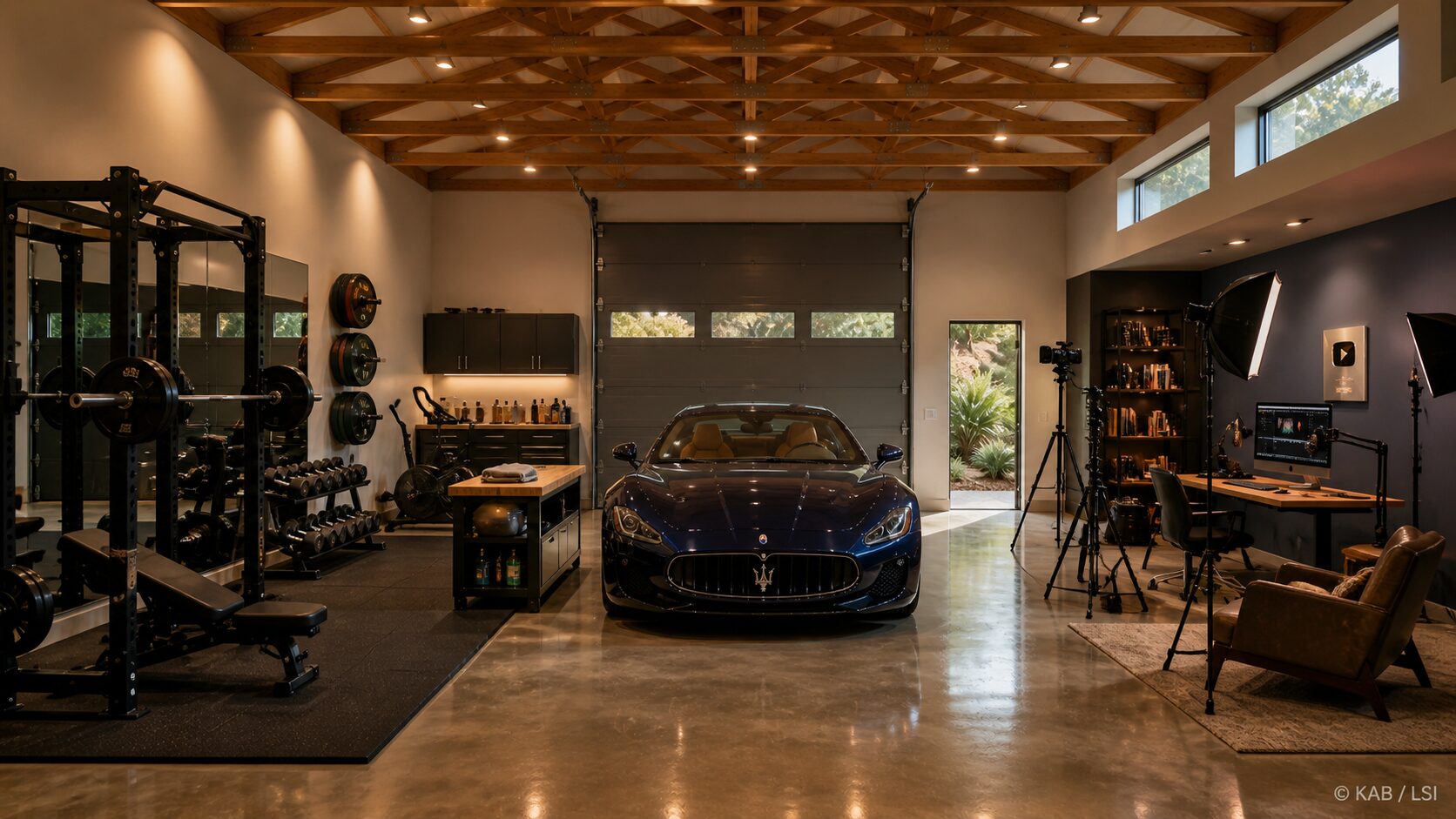
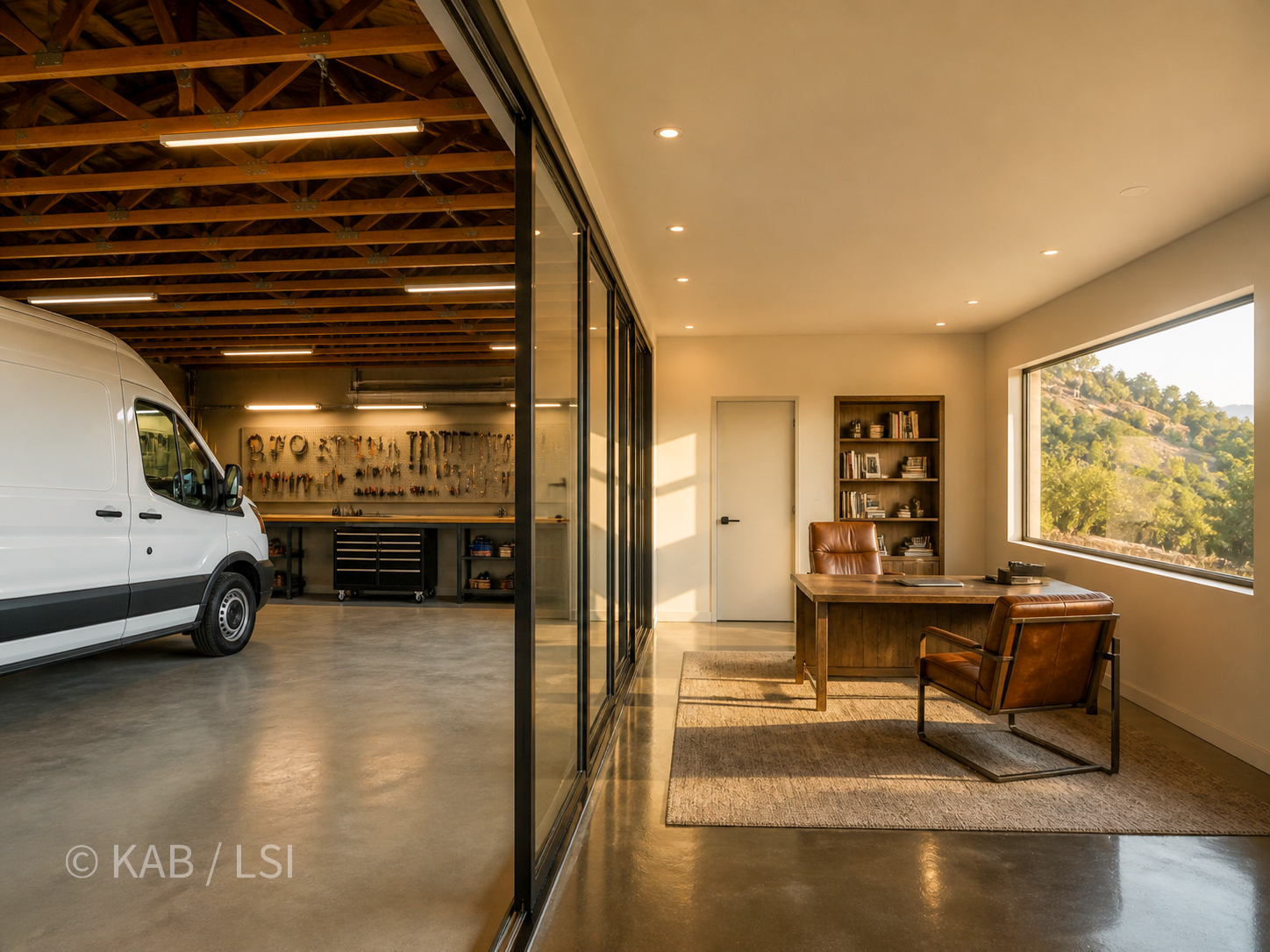
An RV garage shell is, by its nature, fully detached from the main house. It already has the slab, the height, the privacy, and the structural separation that a professional office needs. Finish the interior to office standard — insulation, HVAC, drywall, sound isolation, a separate entrance, a small bathroom — and the same building that could have held a contractor’s vans now holds a six-employee practice.
The reason this matters is the math. You don’t pay for a separate roof, a separate slab, a separate footprint, or a separate permit process. The shell is already there. The interior buildout is the only cost.
Park the office in one corner. Or use the whole bay. Vans in the front, employees in the back. Or the entire structure as the practice. The owner equips the shell for the use the owner needs.
What you’re actually building.
An RV garage isn’t a shed with a tall door. It’s a real building.
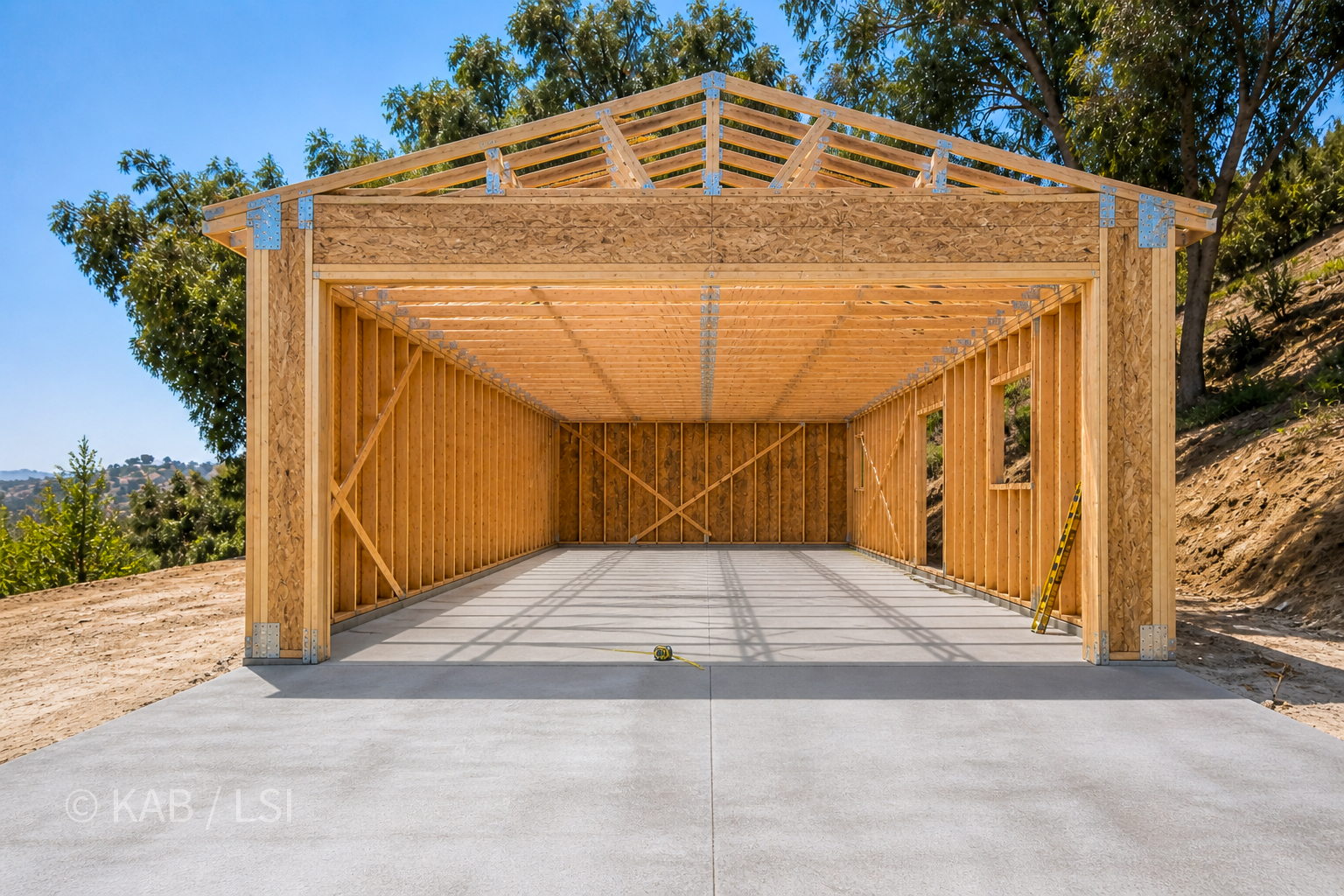
Twenty by sixty on the slab, six inches of reinforced concrete because a Class A motor home weighs what a Class A motor home weighs. Engineered trusses spanning the full depth. A 26 × 66 roof if you give it a normal three-foot overhang — and on a hillside lot, you want concrete tile for fire resistance. That’s a lot of tile. Add the roll-up door, the framing, the sheathing, the windows for daylight, and you’re already in real-building money.
You’ll want to insulate at least the part of it you actually use. You’ll probably want a mini-split for climate control. If the use case is a contractor’s office or a professional practice, you’ll be running insulation, drywall, and HVAC through the whole interior.
The honest comparison: it costs more than people expect when they hear “garage.” It costs less than an ADU because you’re not paying for kitchen plumbing, bedroom egress, the full residential code gauntlet, or the slow ADU permit process. And it’s the most versatile structure you can put on the slab once it’s done.
That’s the math. Not cheap. Worth it.
That is the quiet genius of a well-built outbuilding. You pull a permit for a garage, build it strong, tall, insulated, conditioned, and to code — and then life decides what it needs to become.
That’s why I chased it for ten years.
That’s why I’d still build one for you tomorrow.